Social Media Locations
 Pretty Printout
Here are my social media links, just in case. I’m AlicesAstroInfo on all of them:







November 2022: I’m only really active on the bird app, but these other are me for real, and I’ll switch when we need to.
Seasonal Sunset Watches
Pretty Printout
It’s time for the seasonal sunset watch, every solstice and equinox sunset at Solstice Park in West Seattle. Here are the details for the next several events:
| # | Date | Event Time | Expected Actual Sunset Time |
Official Sunset Time |
Equinox/ Solstice Moment Time |
| 61 | June Solstice 2024 My sunset event will be Friday, June 21, 2024! (The Solstice is actually Thursday, June 20, 2024) |
8:30 pm – 9:30 pm | 8:50 pm | 9:11 pm | 1:51 pm June 20 |
| 62 | September Equinox 2024 Sunday, September 22, 2024 |
6:30 pm – 7:30 pm | 7:00-7:12 pm (trees) | 7:22 pm | 5:44 am |
| 63 | December Solstice 2024 Saturday, December 21, 2024 |
3:45 pm – 4:45 pm | 4:05 pm | 4:20 pm | 1:20 am |
| 64 | March Equinox 2025 Thursday, March 20, 2025 |
6:30 pm – 7:30 pm | 7:00-7:12 pm (trees) | 7:22 pm | 2:01 am |
| 65 | June Solstice 2025 Friday, June 20, 2025 |
8:30 pm – 9:30 pm | 8:50 pm (trees) | 9:11 pm | 7:42 pm |
- When:
- We have noticed that the Sun sets about 10-15 minutes earlier than the USNO‘s official prediction says, because of the horizon altitude. We use the PeakFinder app to determine exact sunset time, but I only use that the day of the event..
- The moment of the solstice/equinox doesn’t usually happen during this event, but I list it here for you to know.
- Where: Solstice Park – all the way up the hill from the tennis courts (or, if you’re not in Seattle, wherever you have a view of the western horizon!)
- Who: Everyone welcome, as usual, but consider your vaccination status when making your decision to attend. (Please do leash your dogs as we usually have a good number of people, kids, and other dogs around.)
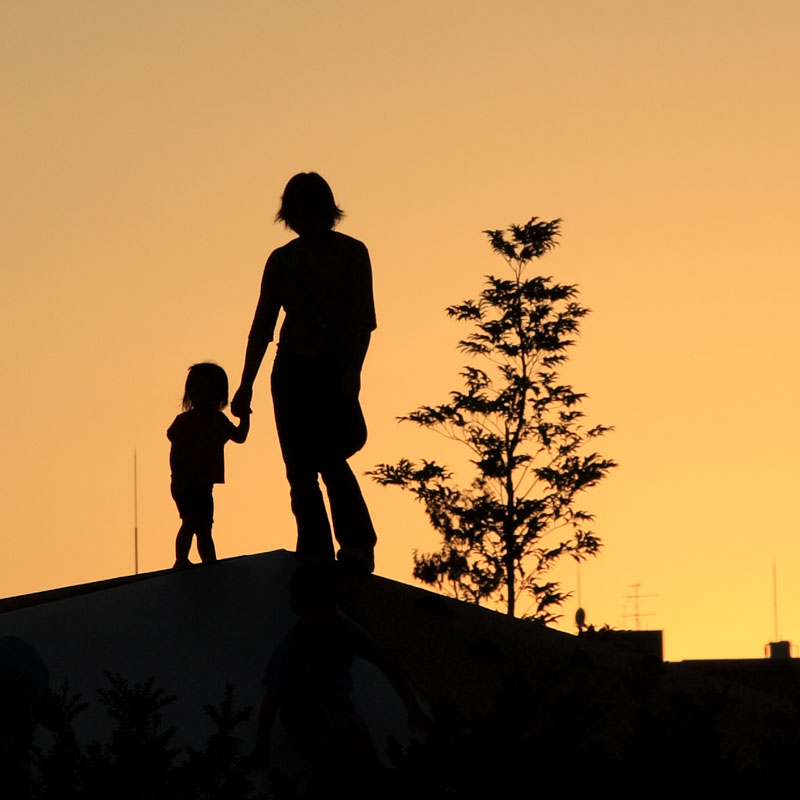
Parent and Child at Sunset by Kazuhiko Teramoto, skyseeker
Come watch the sunset at Solstice Park in West Seattle. I’ll be there even if it is cloudy because sometimes the Sun peeks through just as it begins to set, but if it is driving rain or a thunderstorm I’m staying home with some tea!
If you’re interested – here’s the timing of various celestial events from Seattle, courtesy of the U.S. Naval Observatory Astronomical Applications Department.
This event is my part of the NASA’s Solar System Ambassador program, and thanks to West Seattle Blog for publicizing all of them!
Everyone is welcome, see you there!

~ A l i c e !
Aurora Viewing from Seattle — Basic Tips
Pretty Printout
Aurora viewing from Seattle, basic info, tips, locations and resources.
Summary: ALWAYS LOOK NORTH, and expect it to be dim.
Forecasts for minute-to-minute updates:
The Ovation Model – a prediction: bright green, yellow or red overlapping Seattle means go outside and look.
Soft Serve News – a prediction: Kp over 5 means possible aurora for Seattle, but the higher the better. If it hits 6 go outside.
Current Activity, Estimated Kp, – a measurement: Kp over 5 is good news. Remember the date/time along the bottom are in Universal Time so subtract 7 or 8 hours depending on daylight savings.
Advanced Solar Wind Charge/Direction – a measurement: scroll down. On the left under “Real Time Solar Wind” is a little speedometer thing labeled “Bz.” When this is pointed towards S/-50/Red we have better auroras in the Northern Hemisphere. When it is pointed the other way, the Southern Hemisphere has better aurora.
NOAA’s Space Weather Prediction Center – LOTS of info in one place.
Cloudcover prediction for tonight at 11pm:
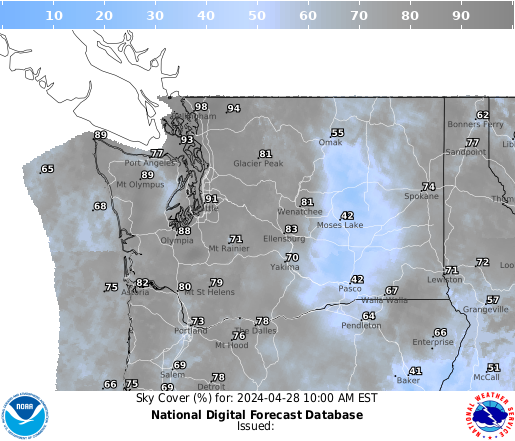
This image should have today’s date on it. If it does not, click on the image and choose “Sky Cover, 11pm” from the table on the left.
Cloudcover information from NOAA
Basics:
What: Possible aurora types: Slight greenish tinge, perhaps brighter columns or curtains in the sky, or a diffuse red glow. Do not be tricked by the normal red/yellow glow from downtown Seattle.
When: Use Timeanddate.com to convert aurora prediction times from UTC to Pacific Daylight or Standard Time.
Where: Always look North for aurorae. When clouds are predicted over Puget Sound, so I recommend viewing from Lake Kachess just past Snoqualmie Pass, or even further East. There may also be chances from Sequim or north of Everett.
How: A digital camera with a long exposure will be better at detecting the slightest glow than your eye, but once it gets bright enough you won’t need the camera anymore.
Tips (from my Twitter stream):
- Alice’s Aurora Tip #1: Be patient, keep an eye on the data (see links below) until you see something. Then turn off the data and enjoy.
- Alice’s Aurora Tip #2: Look North. Be in a dark place.
- Alice’s Aurora Tip #3: Bring a digital camera or phone with a long-exposure setting. Long-exposure images gather more light than your eye with long exposures you may see the aurora first in a viewfinder, and with your eye as it brightens.
- Alice’s Aurora Tip #4: It is usually hard to see from Seattle, even when visible. Give your eyes a chance to adapt. Enjoy the stars too.
Advanced:
When Kp levels surpass 5 it is worth starting to check in. In Seattle, we hope for Kp levels of 6 or greater for the best chance to see the aurora. I explained Kp over here.
*NEW* Recommended Viewing Locations:
My general stargazing location recommendations.
Where Should You Go for Stargazing or to watch the Perseids?
Pretty Printout
See the tab above that says “Seattle Stargazing“? That’s my most recent list of ideas for you.
The map can be found over on Google Maps as well.
My Perseids news coverage 2015
-Full article at West Seattle Blog.
-Interview on KUOW’s The Record for 8/12/2015.
-365 Days of Astronomy What’s Up Tonight, Southern Skies Edition August 2015 (includes tips on astrophotography)
–Alan Boyle’s article at GeekWire about Seattle stargazing spots
~ A l i c e !
Eclipse Events and Resources 2023-2024
Pretty Printout
I will be continuing to add resources and updates to this page.
#1 Most Important Thing
You can easily safely watch a partial solar eclipse, and you should! You just have to know how! Here are many ways: https://solarsystem.nasa.gov/eclipses/2023/oct-14-annular/safety/ (I am linking to the annular eclipse safety information because it is going to be partial here, not total.)
My favorite way to watch a solar eclipse is the indirect method using a colander/spaghetti strainer or other object with small even holes (circles or squares, not long lines).
Turn your back to the Sun.
Hold out the colander until you see its shadow on the ground showing all those little holes. Each one of those is a perfect little image of the Sun! When the Sun is partially eclipsed, you will see little crescents. This works even better if you put down a piece of plain paper or another flat “screen” for the shadow. You can also do this by interleaving your fingers to make a “hashtag” pattern with your fingers, or just look under a tree at the dappled light shining down.
Please do not buy eclipse glasses from a large online marketplace that doesn’t specialize in astronomical viewing equipment or eclipses. The American Astronomical Society maintains a list of reputable vendors of eclipse glasses. In 2017 I had to replace the glasses of almost everyone in my entire campground because they had bought pairs that only an expert like myself could identify as counterfeits and dangerous. It was very hard to tell the difference. https://eclipse.aas.org/resources/solar-filters
The glasses that Seattle Public Library and King County Public Libraries have received through the library eclipse education program are safe.
I will add images of my favorite viewing methods here in detail later. But NASA and AAS (linked above) will always have safe advice.
Here are some alternate languages on safe viewing:
- Amharic 2024 Eclipse Safety – pdf
- Chinese (Simplified) 2024 Annular Eclipse Safety – pdf
- Somali 2024 Eclipse Safety – pdf
- Vietnamese 2024 Eclipse Safety – pdf
- Spanish 2024 Eclipse Safety – pdf
- English 2024 Eclipse Glasses Instructions – pdf
- These are from Eclipse2024.org
Non-visual Observing
Feel/measure for temperature change around the maximum of the eclipse.
Listen, and participate in NASA’s Eclipse Soundscapes Citizen Science project!
My Events: When and Where?
Eclipse Viewing:
Monday, April 8, 2024–10:35am-12:25pm – Maximum (20%) at 11:29am
Location: South Seattle College — grassy field to the east of the south parking lot. Just south of the Wellness Center.
Map.
Parking permits for the lots on campus are for sale at the kiosks. Street parking is available on 16th Ave SW.
I’ll bring whatever glasses I have left, help you be sure you’re viewing safely (as long as you ask me!), and I’ll bring indirect viewers.
All ages welcome! Public is invited! Students and college community members invited!
What if it is cloudy or raining???
- Thunder: cancelled
- Heavy rain/clouds: if it is the kind of weather than might clear up, I am likely to go anyway and wait it out. If it is going to stay socked in, I may cancel. I’ll post information on all the social media and be sure West Seattle Blog knows.
- Light clouds: oh yeah, we’re doing this. Our lighter clouds move around a lot, and the Sun shines through them. REMEMBER: It is NOT safe to view the eclipse through the clouds without other protection. You still need eclipse glasses or indirect methods, even though indirect methods are less likely to work when cloudy.
UPDATE April 8, 2024 9am – Event is still on. If the cloudcover holds this heavy or if it is pouring rain, we will go inside for activities and a livestream. OLY 105 or OLY 120 (theater). Look for signage and my posts on social media.
Resources
Detailed map for October: http://xjubier.free.fr/en/site_pages/solar_eclipses/ASE_2023_GoogleMapFull.html?Lat=47.52534&Lng=-122.34484&Zoom=18&LC=1
Detailed map for April: http://xjubier.free.fr/en/site_pages/solar_eclipses/xSE_GoogleMap3.php?Ecl=+20240408&Acc=2&Umb=1&Lmt=1&Mag=1&Max=1
Livestream Commentary: Mars Perseverance Entry, Descent, and Landing
Pretty Printout
I will be hosting live commentary over Zoom during the Entry, Descent, and Landing of Mars Perseverance.
When: Thursday, February 18, 2021 12:20pm-1:15pm
Where: Register in advance for this meeting (because it is public)
I will be livestreaming the splashdown via https://mars.nasa.gov/mars2020/timeline/landing/watch-online/ within the commentary. I will be chatting directly with you, and will attempt not to be talking over the NASA official commentators, but explaining some terms they use and answering your direct questions.
To watch the livestream of the launch on your own go to NASA’s Mars Landing site to get the best links from NASA.
Also, here are some great activities and information to get you started.
See you later this month!
-Alice
Crew Dragon Splashdown: Sunday August 2, 11:15am Pacific
Pretty Printout
I will be hosting live commentary over Zoom during the Splashdown of Crew Dragon (the return to Earth of NASA’s #LaunchAmerica: the first launch of crew to orbit in a commercial spacecraft).
When: Sunday, August 2, 2020 11:15am Pacific Time
Where: Register in advance for this meeting (because it is public): https://zoom.us/meeting/register/tJYkfuqvrz8tHtF1InWLMWB77rwAopWZc8cl
I will probably be livestreaming the splashdown via https://www.nasa.gov/live within the commentary. I will be commentating directly with you, and will attempt not to be talking over the NASA and SpaceX official commentators, but explaining some terms they use and answering your direct questions.
To watch the livestream of the launch on your own go to https://www.nasa.gov/live to get the best links from NASA.
Here’s my Twitter summary of why the launch was historic, and hence the return-to-Earth as well:
This is going to be a very big step. If I’m checking my history correctly, this will be the first crewed orbital flight of a truly-new design of spacecraft since the Space Shuttles first orbited in ~1981. I’m not dismissing SpaceShipTwo’s accomplishment of suborbital human spaceflight in 2018, but orbital is definitely different.
I am also not dismissing 神舟(Shenzhou) in 2003, though you have to admit that 神舟 is very, very, very similar to Сою́з(Soyuz). In trying to capture the significance of this upcoming crewed Dragon launch, the technology of 神舟 didn’t *feel* as new.
I guess I’m trying to say this *feels* very different and very new. As we’re living in a time of heightened anxiety with the pandemic, things that *feel* like risky new technology can *feel* even newer or riskier. Let us not mistake *feelings* for quantitative and scientifically-conducted risk assessment in any of our scientific endeavors right now, be they human spaceflight, quarantine advice, or the accelerated development of massive SARS-Cov-2 testing and vaccines.
See you in the morning!
-Alice
Comet NEOWISE (C/2020 F3) from West Seattle
Pretty Printout
This comet is visible a couple hours before sunrise for the next few days (July 9, 10, 11) and shortly after sunset after July 12 or so. All dates and times I mention are for West Seattle, Washington, USA. We’re in Pacific Time and at latitude 47.5°. Most of the times will be approximately true for your local time if you’re between 30-50° latitude in the Northern Hemisphere.
The problem with Comet NEOWISE is, even though it is fairly bright for a comet, it is still very close to the Sun from our point of view. When the Sun is in the sky, or even not in the sky but near the horizon, the sky itself is bright, washing out dimmer stars and sky objects. So you have to find the balance point between the peak of the comet’s brightness (which seems to be today July 9) and its distance from the Sun in the sky. Starting July 12 it will get farther and farther from the Sun in our sky, and be visible later and later after sunset.
NEOWISE is currently approximately visual magnitude 2 (smaller numbers are brighter), which is easily visible in a semi-dark sky. You can use these star charts to estimate whether or not a magnitude 2 object will be visible where you are. If you can see as many stars as are in the magnitude 3 chart, or more, then the comet will be visible. If you’re reading this after July 10, check the current magnitude of the comet, and look for the chart for stars dimmer than that.
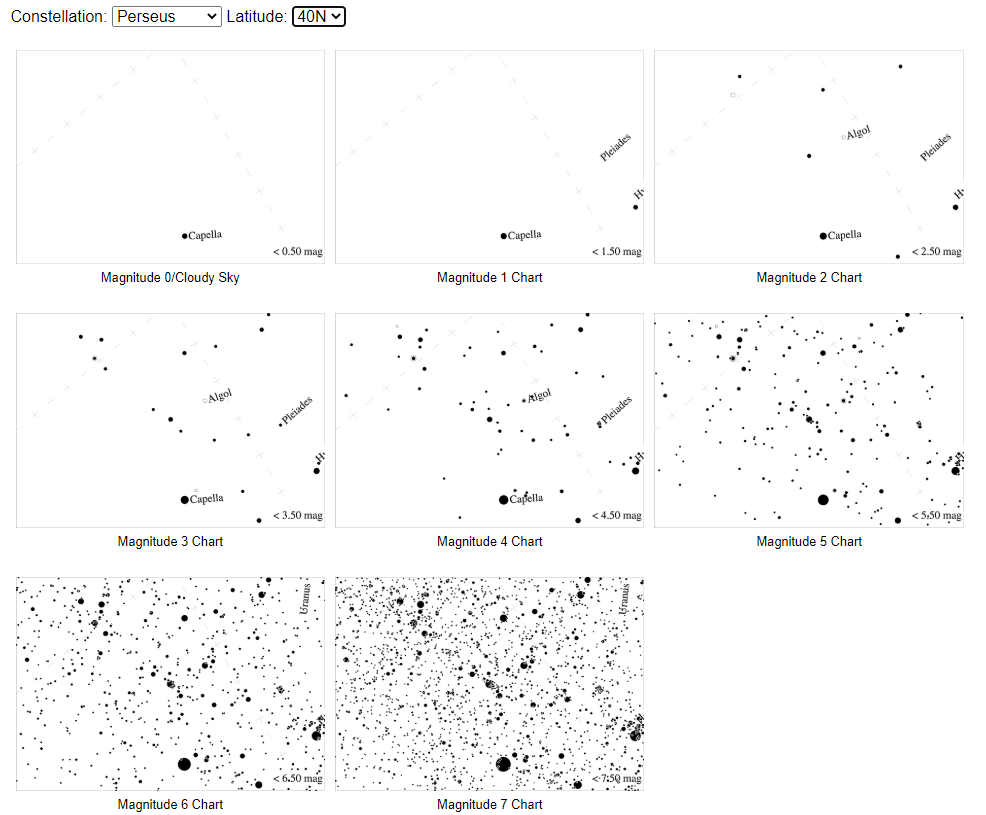
Image from Globe at Night
Morning Sky
Your best chance for July 10 and July 11, 2020 will be around 3-3:40 am looking towards the Northeastern horizon.
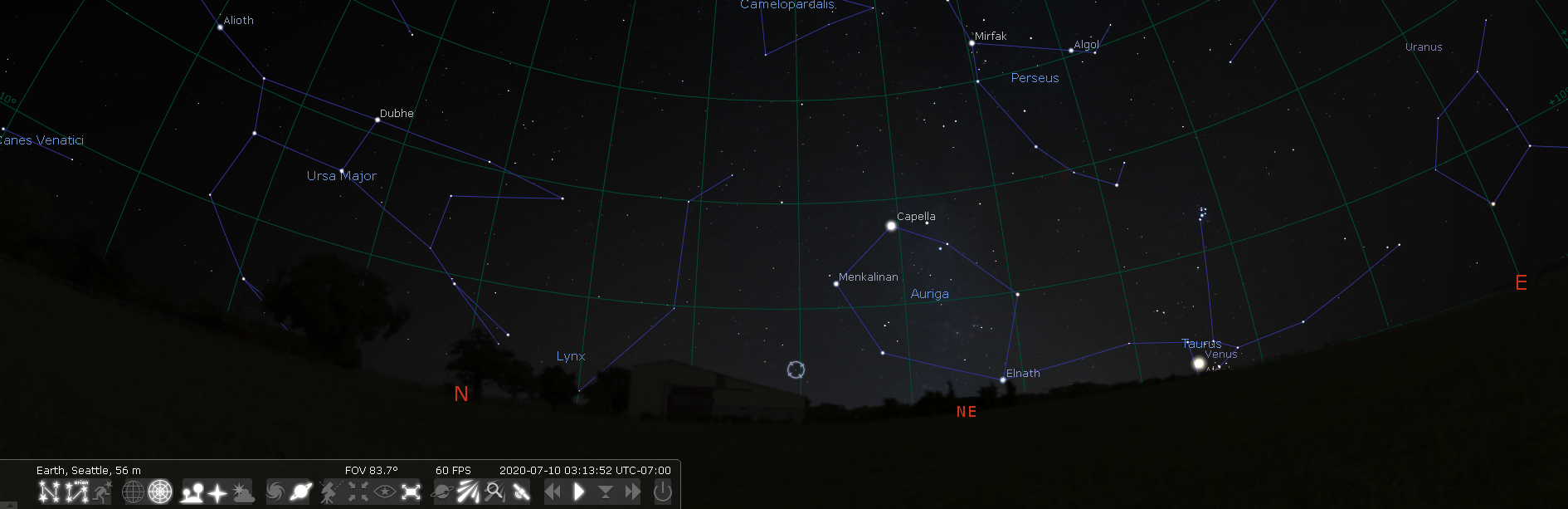
Image from Stellarium
The Northeast horizon is our worst horizon in West Seattle, because that’s directly over Seattle proper. Lots of light pollution. If you want to see this comet, you’ll have to go to the other side of the city. Consider the peninsula or the East side of the Cascades. Wherever you choose, please wear a mask and stay more than 6 feet away from stargazers who aren’t part of your household.
Evening Sky
In a few days, after July 12, it will start to be visible after the Sun sets. You’re welcome to try for it before July 12, but since it sets just an hour after sunset, the odds aren’t good. You’ll be looking north of the Northwest horizon.
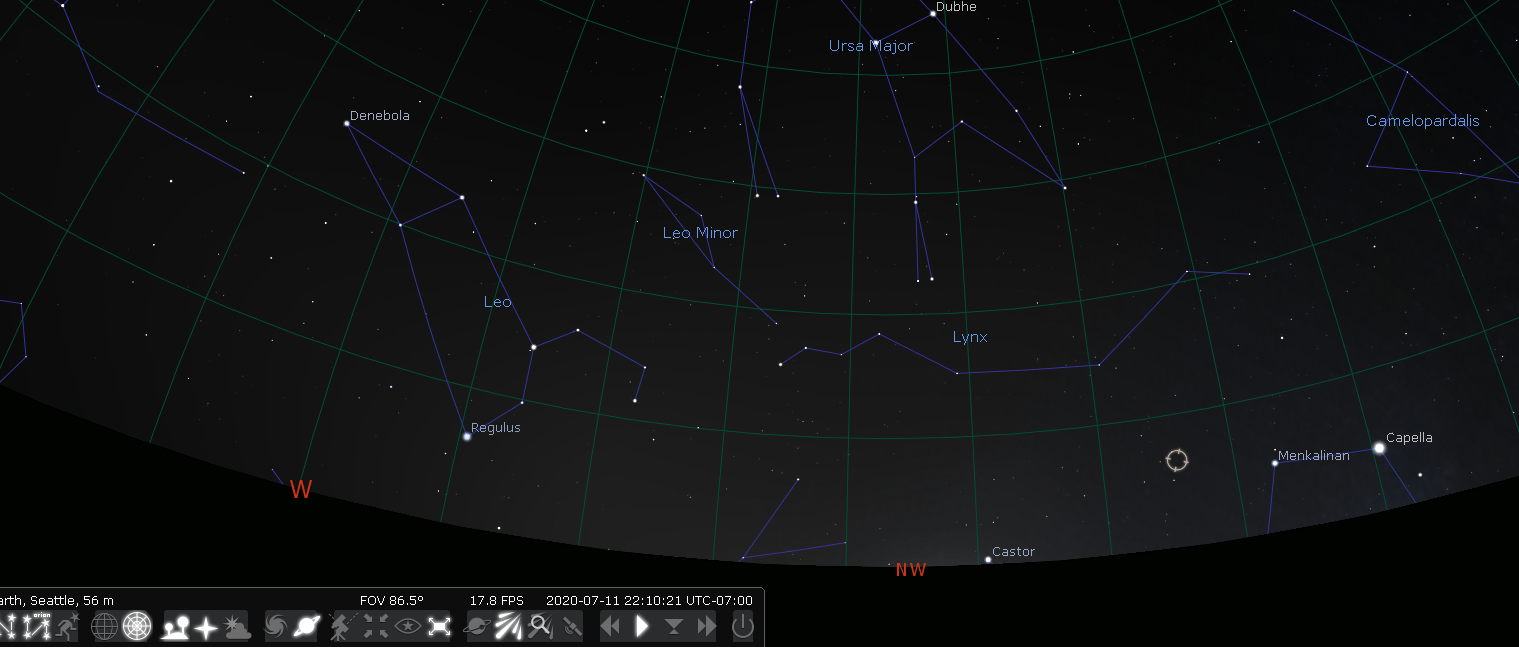
Image from Stellarium
This is a much better horizon from West Seattle, you can view it from most place on the West side of West Seattle. I recommend trying for this one starting July 12 or so, and watch the news to see if other Northern Hemisphere folks have sighted it in their evening skies yet. Wherever you choose, please wear a mask and stay more than 6 feet away from stargazers who aren’t part of your household.
Binoculars
STOP! READ THIS!
If you use binoculars to see this, you must promise me you’ll put them down about 20 minutes before sunrise is predicted to happen. Please. This object is too close to the Sun for me to risk your eyes. Similarly, don’t begin looking for it until at least 5 minutes after you see the Sun finally set below the horizon.
This comet is going to be much more spectacular in binoculars or if you take a long-exposure photograph. A number of phones have “night sight” settings in the camera now, that will also bring out a little more detail, but you’ll need to hold the phone still: rest it on a stable surface.
Any old binoculars will work, they don’t need to be specific to astronomy.
Some useful sources:
- Sky and Telescope has a map of NEOWISE’s positions over the course of July, and some photos by amateur astronomers.
- Globe at Night has some reference star charts so you know how bright the stars are that you’re able to see.
- Earth and Sky has tips on comet viewing, and the picture from Alexander Krivenyshev in Guttenberg, New Jersey is the most like what you’ll see.
- Aerith.net by Seiichi Yoshida is full of detailed information about this comet, along with its most recent brightness.
Keep Looking Up!
-Alice
#LaunchAmerica Live Commentary: SpaceX Demo-2 test flight of Crew Dragon
Pretty Printout
I will be hosting live commentary over Zoom during NASA’s #LaunchAmerica: the first launch of crew to orbit in a commercial spacecraft. The launch is currently targeted for Wednesday, May 27, at 1:33pm Pacific time. I will start my commentary at 1:00pm Pacific Time. This will all be rescheduled if the launch gets rescheduled.
When: Wednesday, May 27, 1:00pm Pacific Time
Where: Register in advance for this meeting (because it is public):
https://zoom.us/meeting/register/tJ0rdu6rqTwiGtThxCfYc7rK-UgGcvDTj6qY
I will probably not be livestreaming the launch within the commentary. It’ll be better quality if you open the Zoom link up in one tab, and the launch livestream in another. I will be commentating directly with you, and will attempt not to be talking over the NASA official commentators, but explaining some terms they use and answering your direct questions. If it does seem to work better, then I will try livestreaming the launch also. We’ll see. Technology, yo.
To watch the livestream of the launch go to https://www.nasa.gov/beourguest and register to get the best links from NASA. I will also post more links here and in the Zoom chat once we’re rolling tomorrow.
Here’s my Twitter summary of why this is historic:
This is going to be a very big step. If I’m checking my history correctly, this will be the first crewed orbital flight of a truly-new design of spacecraft since the Space Shuttles first orbited in ~1981. I’m not dismissing SpaceShipTwo’s accomplishment of suborbital human spaceflight in 2018, but orbital is definitely different.
I am also not dismissing 神舟(Shenzhou) in 2003, though you have to admit that 神舟 is very, very, very similar to Сою́з(Soyuz). In trying to capture the significance of this upcoming crewed Dragon launch, the technology of 神舟 didn’t *feel* as new.
I guess I’m trying to say this *feels* very different and very new. As we’re living in a time of heightened anxiety with the pandemic, things that *feel* like risky new technology can *feel* even newer or riskier. Let us not mistake *feelings* for quantitative and scientifically-conducted risk assessment in any of our scientific endeavors right now, be they human spaceflight, quarantine advice, or the accelerated development of massive SARS-Cov-2 testing and vaccines.
See you tomorrow!
Seasonal Sunset Watches!
Pretty Printout
It’s time for the seasonal sunset watch, every solstice and equinox sunset at Solstice Park in West Seattle. Here are the details for the next several events:
| # | Date | Event Time | Actual Sunset Time |
Official Sunset Time |
Equinox/ Solstice Moment Time |
Thursday, March 19, 2020 |
|
||||
|
|
||||
|
|||||
|
|
||||
| 49 | Summer Solstice 2021
Sunday, June 20, 2021 VIA ZOOM, register in advance for this meeting. https://zoom.us/meeting/register/tJYpcuqgrj4pGN0SPUuK7TGLPT3YRgmcqviO |
8:45 pm-9:15 pm
VIA ZOOM! |
9:00 pm | 9:11 pm | 8:31 pm |
- When:
- We have noticed that the Sun sets about 15 minutes earlier than the USNO‘s official prediction says, because of the horizon altitude.
- The moment of the solstice/equinox doesn’t usually happen during this event, but I leave it here for you to know.
- Where: I will host Summer 2021’s Solstice Sunset watch live on Zoom from an undisclosed West Seattle location.
- I want to support folks in continued social distancing to protect our children and unvaccinated vulnerable folks from SARS-Cov-2/coronavirus.
- I recommend you find a nice outdoor space to watch the sunset from, and tune in to the participatory webcast for some social interaction and celebration of the turning of the seasons.
- Please wear a mask and social distance from people until you discuss your combined comfort levels. Some people aren’t ready to give up masks, some people aren’t vaccinated, some people never worried about transmission in an outdoor setting. Let’s be polite and kind as we all navigate each other’s risk tolerances.
Where: Solstice Park – all the way up the hill from the tennis courts (or, if you’re not in Seattle, wherever you have a view of the western horizon!)- Who: Everyone welcome, as usual. (Please do leash your dogs as we usually have a good number of people, kids, and other dogs around.)
Parent and Child at Sunset by Kazuhiko Teramoto, skyseeker
Come watch the sunset at Solstice Park in West Seattle. I’ll be there even if it is cloudy because sometimes the Sun peeks through just as it begins to set, but if it is driving rain or a thunderstorm I’m staying home with some tea!
If you’re interested – here’s the timing of various celestial events from Seattle, courtesy of the U.S. Naval Observatory Astronomical Applications Department.
This event is my part of the NASA’s Solar System Ambassador program, and thanks to West Seattle Blog for publicizing all of them!
Everyone is welcome, see you there!
~ A l i c e !
March 20 Spring Equinox Sunset Watch — 2019
Pretty Printout
It’s time for the 40th seasonal sunset watch!
40!!!
- When: Wednesday, March 20, 7:00pm (so come at 6:30pm)
- Actual sunset is supposed to be at 7:22pm, but we have noticed that the Sun sets about 15 minutes earlier than the USNO says, because of the horizon altitude.
- The equinox moment is Wednesday, March 20, 2:58pm
- Where: Solstice Park – all the way up the hill from the tennis courts (or, if you’re not in Seattle, wherever you have a view of the western horizon!)
- Who: Everyone welcome, as usual. (Please do leash your dogs as we usually have a good number of people, kids, and other dogs around.)
Parent and Child at Sunset by Kazuhiko Teramoto, skyseeker
Come watch the sunset at Solstice Park in West Seattle. I’ll be there even if it is cloudy because sometimes the Sun peeks through just as it begins to set, but if it is driving rain or a thunderstorm I’m staying home with some tea!
If you’re interested – here’s the timing of various celestial events from Seattle, courtesy of the U.S. Naval Observatory Astronomical Applications Department:
Sun and Moon Data for One Day
U.S. Naval Observatory
Astronomical Applications Department
Seattle, King County, WA (Longitude W122° 20′, Latitude N47° 38′)Wednesday, March 20, 2019 Pacific Daylight Time
Sun
Begin civil twilight 6:42 a.m.
Sunrise 7:12 a.m.
Sun transit 1:17 p.m.
Sunset 7:22 p.m.
End civil twilight 7:53 p.m.
Moon
Moonrise 5:47 p.m. on preceding day
Moon transit 12:45 a.m.
Moonset 7:28 a.m.
Moonrise 7:08 p.m.
Phase of the Moon on March 20, 2019: Full Moon at 6:43 p.m. (local daylight time)
This event is my part of the NASA’s Solar System Ambassador program, and thanks to West Seattle Blog for publicizing all of them!
Everyone is welcome, see you there!
~ A l i c e !
December 21 Winter Solstice Sunset Watch — 2018
Pretty Printout
It’s time for the 39th seasonal sunset watch!
- When: Friday, December 21, 4:05pm (so come at 3:45pm)
- Actual sunset is supposed to be at 4:20pm, but we have noticed that the Sun sets about 15 minutes earlier than the USNO says, because of the horizon altitude.
- The equinox moment is Friday, December 21, 2:23pm
- Where: Solstice Park – all the way up the hill from the tennis courts (or, if you’re not in Seattle, wherever you have a view of the western horizon!)
- Who: Everyone welcome, as usual. (Please do leash your dogs as we usually have a good number of people, kids, and other dogs around.)
Parent and Child at Sunset by Kazuhiko Teramoto, skyseeker
Come watch the sunset at Solstice Park in West Seattle. I’ll be there even if it is cloudy because sometimes the Sun peeks through just as it begins to set, but if it is driving rain or a thunderstorm I’m staying home with some tea!
If you’re interested – here’s the timing of various celestial events from Seattle, courtesy of the U.S. Naval Observatory Astronomical Applications Department:
Sun and Moon Data for One Day
U.S. Naval Observatory
Astronomical Applications Department
Seattle, King County, WA (Longitude W122° 20′, Latitude N47° 38′)Friday, December 21, 2018 Pacific Standard Time
Sun
Begin civil twilight 7:19 a.m.
Sunrise 7:55 a.m.
Sun transit 12:08 p.m.
Sunset 4:20 p.m.
End civil twilight 4:56 p.m.
Moon
Moonset 6:30 a.m.
Moonrise 3:52 p.m.
Moon transit 11:43 p.m.
Moonset 7:41 a.m. on following day
Closest Primary Moon Phase: Full Moon on December 22, 2018 at 9:49 a.m. (local standard time)Phase of the Moon on December 21, 2018: Waxing Gibbous with 99% of the Moon’s visible disk illuminated.
This event is my part of the NASA’s Solar System Ambassador program, and thanks to West Seattle Blog for publicizing all of them!
Everyone is welcome, see you there!
~ A l i c e !